

Work and Non-Work Study

 Team Management Profile
TMS Global Research Paper — Exploring the differences between work and non-work preferences
Introduction
A large range of instrumentation is now being used in industry, commerce and government to assess personality, managerial style and to predict work behaviour. However, measures created and tested in specific contexts are frequently applied elsewhere without considering their validity or applicability in new situations. Instruments that were originally designed for testing children, prisoners, or people in medical situations are introduced into the workplace with the assumption they will be equally valid in their measurement and in the feedback provided. Examples include the 16PF (originally non-situation specific) and the Myers-Briggs Type Indicator® (MBTI®) assessment, which was originally developed to assist young people with life choices based on Jung’s type theory (1923). TMS Global developed instruments addressing both psychological and sociological dimensions, examining psychological instruments within their sociological context. The TMS Global instruments are all examples of those that have been especially developed for use in the work situation.
Study 1
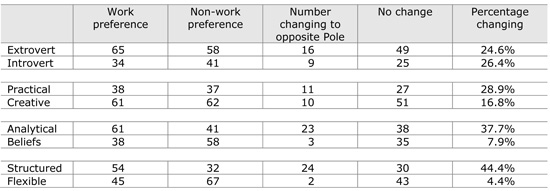
A sample of 99 Training and Development managers described their preferences for Team Management Profile (TMP) constructs at work versus outside work. The findings showed that work, at least for this group of managers, required a more Analytical rather than Beliefs-based preference, and more Structured than Flexible preference. The findings support that preferences are not consistent for everyone and align with earlier research on different orientations in work and non-work settings.
Key Insight: Study 1 found that work environments pull preferences towards more Analytical and Structured orientations — suggesting the workplace itself shapes how people approach tasks.
Study 2
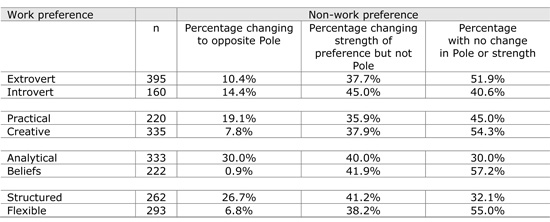
A sample of 555 respondents (including 282 from prior research) described their TMP construct preferences in both contexts. The sample included ages 20–68 from 26 countries, with the largest representation from Australia (62%), Germany (13%), England (7%), and USA (6%). Professional backgrounds included HR/Trainer (62%) and Psychologist (4%). The results demonstrated significant differences between work and non-work preferences:
- For Structure–Flexible: 47% favoured Structure at work versus 38.2% in non-work settings.
- For Analytical–Beliefs: 60% showed Analytical work preferences but only 42% outside work.
This is convincing evidence that people’s preferences at work can be substantially different from their preferences outside work.
At Work
47% favour Structure; 60% show Analytical preferences. The workplace pulls people towards systematic, evidence-based approaches.
Outside Work
38.2% favour Structure; 42% show Analytical preferences. Non-work settings allow more flexibility and values-based decision-making.
Comparative Samples by Gender
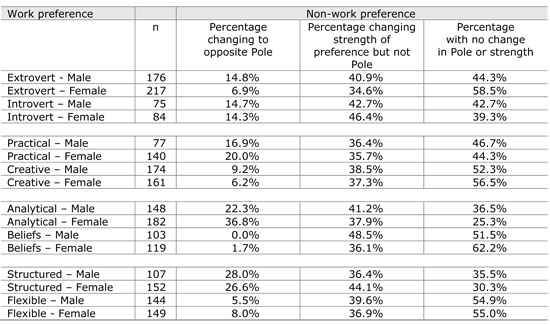
Analysis of male (n=251) and female (n=301) samples revealed notable patterns. 36.8% of women revert to Beliefs preferences outside of work compared with 22.3% for men. Only 25.3% of women indicated no change in pole or strength between the two environments.
Comparative Samples by Age
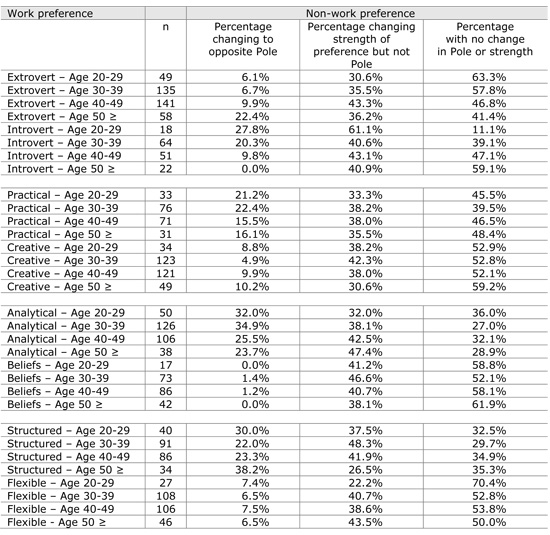
Age analysis revealed that 22.4% of the Extrovert work preference group aged 50 and over shift to being introverted outside work, compared with an average of approximately 8% for those in the lower age groups. Younger employees aged 20–39 with Introvert work preferences showed approximately 22% shifting to extroversion outside work, versus 7% for those aged 40 and over.
Key Insight: Older extroverts (50+) are nearly three times more likely to shift to introversion outside work than younger employees — suggesting that mature professionals may deliberately adopt more outgoing work behaviours.
Conclusion
The TMS Global instruments are all examples of those that have been especially developed for use in the work situation. Therefore it is as unwise to use them outside of that context as it is to use other instruments that have been devised for non-work assessment in situations at work. Extrapolating results between work and non-work contexts is inadvisable.
Inside the Work vs Non-Work Study
How preferences shift between contexts
Training and Development managers surveyed in the initial study
Broader cross-professional sample in the follow-up study
Including Australia, Germany, England, and USA