

How do you handle decision-Making in uncertainty?
When making decisions, does your team see opportunity or threat? How resilient are they? How do they handle change? The Opportunities-Obstacles Quotient (QO₂) Profile reveals the risk orientation driving your team’s response, so you can make smarter decisions, and lead through uncertainty and transformation with clarity.
Change is constant. Restructures, market shifts, digital transformation, AI adoption, mergers, your team faces pressure from every direction. But it’s not the change that derails teams, it’s how they respond to it. QO₂ shows you whether you lean into risk or pulls away from it and what to do about it.



What is the QO₂ ?
Overview of the Assessment
In today’s environment, where adaptability, rapid decision-making and foresight are non-negotiable, QO₂ provides a proven framework to:
- Strengthen personal and team resilience
- Improve decision-making under pressure
- Navigate ambiguity and transformation with confidence
The Risk-Orientation Model
QO₂ shows where you and your team put your energy when making decisions – do you see the possibilities or focus on the risks? It helps uncover how each person responds to challenge and change, and how resilient or cautious they’re likely to be. The best teams balance both.
Opportunities Focus
- Sees potential gains and possibilities
- Driven by “what we could achieve”
- Energised by potential
- Moves quickly toward action
Obstacles Focus
- Sees potential risks and constraints
- Driven by “what could go wrong”
- Energised by risk mitigation
- Moves carefully through analysis
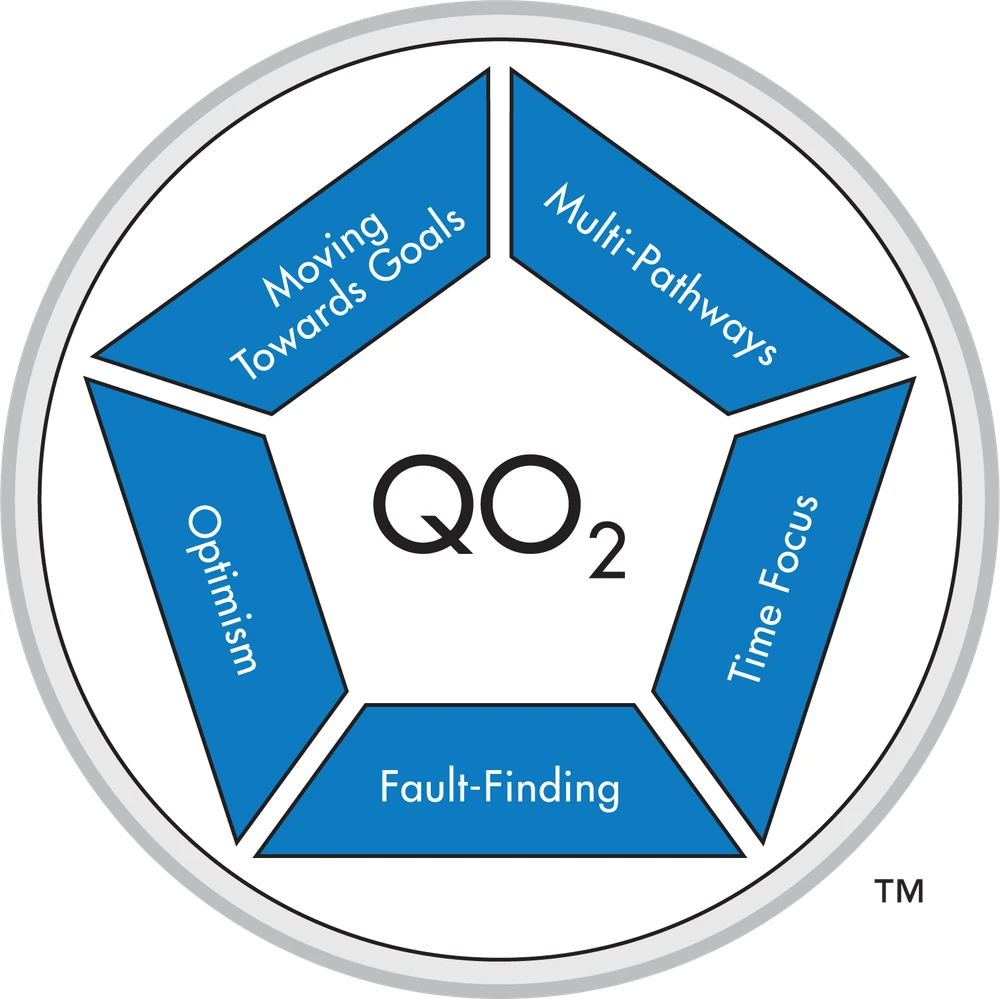
The Five Subscales of risk orientation QO₂ measures
1. MTG Energy
Moving Towards Goals: Your drive, determination and enthusiasm to achieve goals
2. Multi-Pathways
Your ability to generate multiple possible pathways around obstacles
3. Optimism
The psychological belief that you’re likely to succeed at what you set out to do
4. Fault-Finding
The effort you put into looking for potential problems, risks and what could go wrong
5. Time Focus
Whether you tend to focus on the future and potential or the past and proven paths
Two Strategic Indices supporting leadership and adaptability
Handling Change Index
How effectively you navigate change and uncertainty based on your opportunity-obstacle balance
Resilience Index
Your capacity to recover from setbacks and maintain performance under pressure
QO₂ Use Cases & Applications
When to Use QO₂
- Before major change: Establish a clear baseline
- During transformation: Identify adaptation gaps
- Post-crisis or recovery phase: Assess where support is needed
- Strategic planning cycles: Ensure leadership has balanced view of risk and opportunity
- Mergers and acquisitions: Reconcile differing organisational cultures
- Leadership transitions: Equip new leaders with self and team awareness
For Change Leaders
Lead transformation with insight
- Measure change appetite at scale with anonymised data across whole organisations
- Segment results by level or department to spot patterns across teams and functions
- Anticipate where pushback will come from and plan for it
- Build change strategies that engage both opportunity-seekers and risk-mitigators
- Create communication approaches tailored to different risk orientations
For HR & L&D Leaders
Build resilient organisations
- Assess organisational resilience and capacity to handle change
- Design leadership development that strengthens decision-making
- Equip leaders to build teams that recover fast and adapt intelligently
- Develop resilience as a measurable, strategic capability
- Use QO₂ data to align talent, culture and change-readiness across functions and levels
For Consultants & Coaches
Elevate leadership capability
- Use QO₂ to develop more self-aware, adaptive leaders
- Coach clients to understand how their risk orientation shapes their decisions
- Replace vague “resistance” narratives with clear data on change preferences
- Offer evidence-based development plans grounded in measurable psychometrics
For Executive Teams
Build strategic decision-making
- Understand how risk orientation affects strategic choices at the highest level
- Prevent groupthink by ensuring board and C-suite discussions include both opportunity and risk voices
- Build executive resilience during times of sustained pressure
- Improve decision quality by leveraging diverse perspectives

Success Stories
See how organisations are using QO₂ to navigate change, build resilience and make better decisions.

We use the QO2 in our leadership programs to help build capability. For example, it made one leader aware that his instinct was to focus on why things won't work, so he caught himself mid-conversation and reframed to 'how might it work', learning when to lean into a strength and when to balance it.
TMS training is superb! I love that the QO2 taps into people's emotions… with such strong emphasis now on psychosocial health, I can see that this tool could be really useful to unpick issues around stress, overachievers, burnout etc.
The feedback for Leading Change and Thriving Through Change has been overwhelmingly positive and the content is absolutely hitting the mark with all levels of leadership.
Get Started with QO₂

Find a QO₂ consultant
Work with one of our accredited practitioners in your region to bring QO₂ to your team and organisation. Speak with our team to find the right coach for your needs.

Get Accredited in QO₂ to deliver workshops
Join 24,000+ practitioners globally. Gain lifetime QO₂ accreditation, Portal access, resources and community with no annual renewal fees.
Frequently Asked Questions
How is QO₂ different from personality assessments?
QO₂ focuses specifically on risk orientation in work contexts – how you approach goals, challenges and change. It doesn’t measure personality traits. This narrow focus makes it highly actionable for change management, decision-making, leadership capability development and team dynamics.
Is high opportunity focus always better?
No. High opportunity focus can lead to reckless decisions, missed risks and costly mistakes if not balanced with obstacle awareness. The best teams have diversity of risk orientation – some people scanning for opportunities, others watching for risks. QO₂ helps you build that balance intentionally.
Can QO₂ predict how someone will perform under pressure?
QO₂ includes a Resilience Index that indicates capacity to recover from setbacks and maintain performance under pressure. However, resilience is also influenced by context, support systems and experience. QO₂ shows natural inclination and areas for growth or development.
Should we use QO₂ before launching major change initiatives?
Yes. Understanding your team’s risk orientation before change begins allows you to tailor communication to different risk perspectives, anticipate where resistance will emerge and why, build change teams with balanced risk orientation and create a positive shared language around different views – avoiding labelling obstacle-focused people as “resisters.”
How long does the QO₂ questionnaire take?
Most people complete it in 15-20 minutes. It’s self-paced and can be saved and resumed if needed.
Can teams with very different risk orientations work well together?
Yes, if they understand their differences and respect both perspectives. Without awareness, opportunity-focused people can see obstacle-focused people as “negative” or “blockers,” and obstacle-focused people can see opportunity-focused people as “reckless” or “naive.” QO₂ reframes these differences as complementary, not conflicting.
Is QO₂ validated and scientifically credible?
Yes. QO₂ was reviewed by the British Psychological Society in 2006 and is grounded in TMS’s 40+ years of research. It meets rigorous psychometric standards for validity and reliability.
How does QO₂ relate to TMP?
TMP shows how people prefer to work (team roles, work preferences). QO₂ shows how they approach risk and change. Together, they explain dynamics you’d miss with either tool alone. For example, a Thruster-Organiser (TMP) with high obstacle-focus (QO₂) will drive action cautiously – very different from a Thruster-Organiser with high opportunity-focus.
Can QO₂ be used for hiring or selection?
No. QO₂ is designed for development, not selection. It’s a tool for understanding existing teams and helping them work more effectively together, not for screening candidates.
What if my whole team is high opportunity-focus (or high obstacle-focus)?
Homogeneous teams make faster decisions but often make worse ones. If everyone is opportunity-focused, nobody’s watching for risks. If everyone is obstacle-focused, nobody’s pushing forward. QO₂ helps you recognise this imbalance and either bring in diverse perspectives for critical decisions, intentionally assign devil’s advocate or opportunity scout roles, or develop greater flexibility in your current team.
What do you get with the QO₂?
The QO₂ gives you three things: a comprehensive, personalised feedback report covering your Opportunities-Obstacles score, subscale breakdown, resilience index and practical strategies; two years of access to the TMS Global Respondent Platform, including the Project Health Check tool, team comparison features and ongoing development resources; and a Personal Development Workbook to help you apply your results and build action plans.
What do I get with the 2-year TMS Global Respondent Platform access?
Alongside your report, you get two years of access to the TMS Global Respondent Platform. This includes the Project Health Check diagnostic tool to measure the risk management approach in any project your team is undertaking, team comparison features, and ongoing development resources.
What’s in the Personal Development Workbook?
You’ll also receive a structured workbook to help you apply your results. It guides you to reflect on your QO₂ results in real situations, identify where your risk orientation serves you and where it doesn’t, develop flexibility to adapt your approach based on context, and create action plans for specific goals or challenges.
What’s included in the QO₂ feedback report?
Each person receives a detailed, personalised report covering their overall Opportunities-Obstacles score (QO₂), a breakdown across all five subscales (Multi-Pathways, Time Focus, Energy, Optimism and Fault-Finding), a Handling Change section with guidance on navigating change, a Resilience Index score, an interpretation guide explaining what the scores mean, and practical strategies for working effectively with people who have different risk orientations.
How does the QO₂ integrate with other TMS Global products?
QO₂ is most powerful as part of the complete TMS Global methodology. Depending on what you’re trying to achieve, team insight, leadership development, or managing organisational change, QO₂ pairs with different tools to give you a fuller picture.
How does QO₂ support team insight?
Combining the Opportunities-Obstacles Profile (QO₂) with the Team Management Profile (TMP) and Team Signals gives you a three-dimensional view of your team. TMP clarifies work preferences and each person’s team role contribution. QO₂ shows how people approach goals, risk and uncertainty. Team Signals diagnoses how the team is functioning right now. Together, they reveal who your team is, how resilient they are, and where to focus to improve effectiveness.
How does the QO₂ support leadership development?
For targeted leadership development, combine QO₂ with TMP, the Linking Leader Profile (LLP|360) and the Windows on Work Values Profile (WoWV). TMP highlights leadership style and energy across different types of work. LLP|360 identifies which Linking Skills matter most and how effectively a leader demonstrates them. QO₂ adds insight into resilience, drive and decision-making under pressure. WoWV reveals the values and motivators shaping leadership behaviour and cultural fit. The result is focused development that targets the specific skills, behaviours and mindsets that will make the greatest difference for that leader.
How does the QO₂ help manage organisational change?
Navigating restructures, mergers, strategy shifts or growth with less friction starts with combining QO₂, TMP and WoWV. TMP shows how work gets done, where gaps exist, and how people collaborate during change. QO₂ explains how individuals and teams respond to uncertainty, so you know how to bring them on the journey. WoWV uncovers the values driving engagement and resistance. Together, they give you a shared, practical language for guiding teams through change and aligning work preferences, risk orientation and values to support sustainable transitions.