

Align Values, Transform Teams: Understand What Drives Behaviour at Work
Values show up in structures, incentives, policies and the way decisions are made. When personal values align with organisational culture, teams thrive. When they clash, performance suffers.
The Window on Work Values (WoWV) Profile reveals the values that shape how people work, make decisions and collaborate. It’s a practical tool for aligning individual values, team behaviour and organisational direction. Discover where alignment exists and where leadership needs to stretch.



The Challenge
Your organisation might promote one set of values – collaboration, innovation and accountability. But are people experiencing something different: silos, risk aversion, finger-pointing?
You’ve hired talented individuals and tried to maximise “culture fit,” but teams still clash in ways no one can quite explain.
You’ve launched team-building programs, clarified processes and roles, encouraged people to “be more flexible” – but while these actions may have helped temporarily, engagement scores stay flat.
Here’s what was missed: tension often comes from unspoken values mismatches.
WoWV makes the invisible beliefs that drive behaviour at work, visible. It shows you the values actually shaping how work gets done in your organisation – what matters, what gets prioritised and what feels acceptable to you and your team members.
How WoWV Works
The Two-Dimensional Values Framework
WoWV maps values across two critical dimensions:
Dimension 1: Self vs. Group Focus
Where do you place your primary attention: individual goals and autonomy, or collective goals and belonging?
Dimension 2: Organisational Constraint vs. Freedom
Do you prefer structure, rules and clear boundaries – or flexibility, autonomy and open-ended direction?
These dimensions create a circular model where:
- Adjacent values are complementary
- Opposite values create tension
The Eight Value Types
1. Individualism
Focus on autonomy, personal achievement, personal accountability and ownership of outcomes.
“I’m most effective when I take responsibility for my own decisions.”
2. Independence
Focus on self-direction, minimal constraint and freedom from close supervision.
“I work best when I control my own path.”
3. Empowerment
Focus on enabling others, sharing power and collective agency.
“I’m most effective when we all have a voice and influence.”
4. Equality
Focus on fairness, shared outcomes and eliminating hierarchy.
“I work best when everyone is treated the same.”
5. Collectivism
Focus on group harmony, belonging and shared identity.
“I succeed when the team succeeds.”
6. Conformity
Focus on fitting in, following norms and maintaining stability.
“I work best when expectations are clear and shared.”
7. Compliance
Focus on rules, standards and adherence to authority.
“I succeed when I follow the right process.”
8. Authority
Focus on hierarchy, structure and clear lines of power.
“I work best when roles and decision rights are defined.”
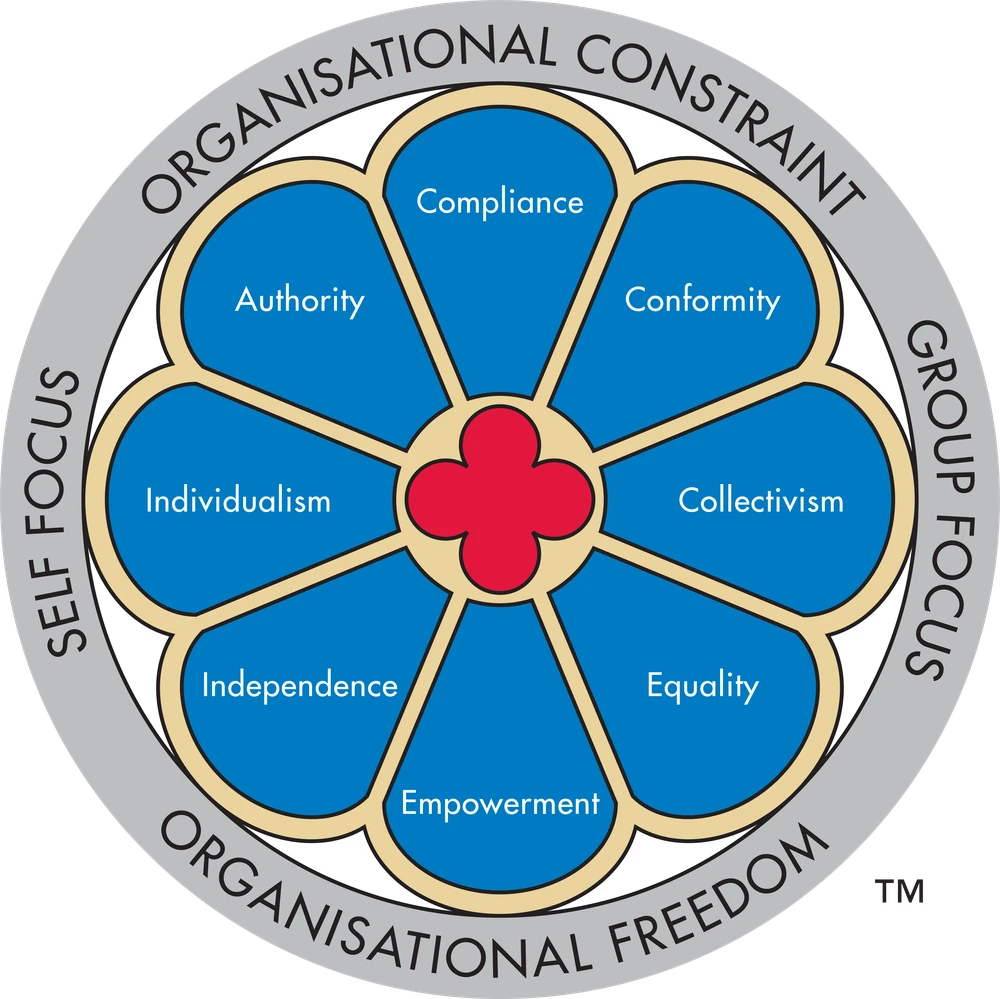
Window on Work Values Model
Why the Circular Model Matters
Values aren’t good or bad – they’re contextual. What matters is:
Alignment between personal values and organisational culture
Balance across the team (too much of any one value creates bias)
Awareness of tension (when opposite values clash, leaders need the skill to stretch into the appropriate value)
WoWV helps you see where alignment exists, where there might be friction and what to do about it.
What You Get with the WoWV
Use Cases & Applications
Leadership Alignment & Strategy Delivery
How WoWV supports leadership alignment
- Build executive teams that share values or manage differences skillfully
- Align culture with strategic execution
- Lead change with self-awareness of your values and others’
- Build leadership flexibility through multiple value lenses
- Navigate executive team tensions rooted in values differences
Cultural Alignment & Organisational Change
How WoWV supports culture change
- Address the disconnect where organisations promote one set of values but reward another
- Clarify what values are actually practised vs. espoused
- Identify where systems, incentives and policies misalign with stated values
- Build culture change strategies grounded in values data
- Measure cultural integration during mergers or acquisitions
Team Clarity & Behaviour Mapping
How WoWV supports team clarity
- Co-create team ground rules based on actual values, not generic best practices
- Understand how your team’s value-mix works together (and where it clashes)
- Surface unspoken expectations before they become conflict
- Create team charters that reflect real values, not aspirational ideals
- Build strategies for expressing values in constrained environments
Conflict Resolution
How WoWV supports conflict resolution
- Understand root causes of interpersonal tension
- Diagnose whether conflict is about tasks, roles or values
- Reframe “difficult people” as “different values”
- Build bridges between opposing values through dialogue and skill
- Prevent values-based conflict from derailing teams
Cross-Cultural Teams
How WoWV supports cross-cultural teams
- Navigate cultural differences with data, avoiding stereotypes
- Build shared values for global teams working across boundaries
- Address tension between local and global values expectations
- Create inclusive team norms that honour diverse values
Merged & Newly-Formed Teams
How WoWV supports new and merged teams
- Accelerate integration by making values explicit
- Surface hidden differences early
- Identify where teams might clash (opposite values)
- Build shared team identity grounded in complementary values
- Track values alignment over time as teams mature
Performance & Engagement Management
How WoWV supports engagement
- Understand disengagement that isn’t about compensation or workload
- Identify where personal values misalign with organisational demands
- Design retention strategies that address values fit
- Build roles and environments that honour diverse values
Timing Guidance
When to use WoWV for maximum impact:
- New teams: Within the first month to establish values-based ground rules
- Mergers and acquisitions: Before integration begins, then at 180 days
- Organisational change: When values shifts are required (e.g., start-up to scale-up, public to private)
- Leadership transitions: When a new leader’s values differ from the team or organisation
- Engagement crises: When traditional engagement levers (pay, benefits, recognition) aren’t working

Why WoWV Works
WoWV is grounded in rigorous values research and delivers practical, actionable insights for teams and organisations.
How WoWV Integrates with the Complete TMS Global System
WoWV is most powerful when combined with other TMS Global diagnostics:
Deeper Team Understanding
Understand not just how your team works, but why.
Combine: WoWV + TMP
How these products work together
- WoWV identifies the values driving behaviour and motivation at work
- TMP shows how people prefer to work, their team roles, collaboration patterns and work preferences
Result: A complete picture of your team. Understand why two people with the same work preferences might still clash.

Values-Based Leadership Development
Develop leaders who understand what drives their leadership approach.
Combine: WoWV + LLP|360
How these products work together
- WoWV uncovers the values shaping leadership behaviour and decision-making
- LLP|360 shows leadership behaviours and effectiveness against key Linking Skills
Result: Understanding why a leader micromanages (Authority or Compliance values), why a leader avoids difficult decisions (Collectivism or Equality values) and how to develop leadership flexibility across different value contexts.

Targeted Leadership Development
Develop leaders against what their role actually requires.
Combine: TMP + LLP|360 + QO2 + WoWV
How these products work together
- TMP highlights leadership style and energy across different types of work
- LLP|360 identifies which Linking Skills matter most for the role and how effectively they are demonstrated
- QO2 adds insight into resilience, drive and decision-making under pressure
- WoWV reveals values and motivators shaping leadership behaviour and cultural fit
Result: Focused leadership development that targets the skills, behaviours and mindsets that will make the greatest difference.

Success Stories
See how organisations are using WoWV to align values, resolve tension and build stronger teams.

Being aware of how to work with other personalities leads to achieving better outcomes.
The leadership team are more constructive as we operate with trust, have greater understanding of others' priorities and can be more effective as a result.
A greater understanding of our leadership team mates has led to more candor, and more forward thinking [in terms of] conversations that lead to innovative thinking and positive change.
Get Started with WoWV

For Organisations & Teams
Find a TMS Global Practitioner
Work with one of our 24,000+ accredited practitioners to bring WoWV to your team or organisation.
Speak with a TMS Global Expert
Navigating a merger, culture change or values misalignment? Let’s discuss how WoWV can help.
Request Sample Report
See the depth of insights of the WoWV reports.

For Consultants & HR Professionals
Get Accredited in WoWV
Join 24,000+ practitioners globally. Deliver values-based team and organisational development.
Already TMS Global Accredited? Add WoWV
Add WoWV to your toolkit alongside TMP, QO2, LLP|360 and Team Signals.
Free Resources
Frequently Asked Questions
How is WoWV different from personality assessments?
WoWV measures values, not personality. Values are beliefs about what’s important – they drive motivation, decisions and what feels right or wrong at work. Personality describes traits and behavioural tendencies. Example: two people might both be extraverted (personality) but have very different values. One values Individualism (stand out), the other values Collectivism (fit in). WoWV explains the why behind behaviour.
Can values change over time?
Yes, but slowly. Core values are relatively stable, but they can shift based on: life stage and experience, organisational culture (over years) and major life events such as career transitions or new leadership roles. Most people reassess WoWV every 2-3 years, or during significant transitions.
What if someone’s personal values conflict with organisational values?
This is common and WoWV helps address it constructively. Name the conflict – make it explicit instead of letting it simmer. Create pathways – design roles, projects or flexibility that honour both. Create awareness – being aware of misalignment means leaders can learn to stretch into the role required from them.
Can teams with very different values work well together?
Yes, if they understand the differences and build skills to navigate them. Adjacent values (e.g., Individualism + Independence) work naturally together. Opposite values (e.g., Authority + Empowerment) require dialogue, compromise and shared agreements. WoWV doesn’t eliminate differences – it makes them discussable and manageable.
How long does the WoWV questionnaire take?
Most people complete the 64-item questionnaire in 15-20 minutes. It’s self-paced and can be saved and resumed if needed.
Is WoWV validated and scientifically credible?
Yes. WoWV is grounded in decades of values research from Rokeach, Schwartz and Triandis – among the most respected scholars in values research. It meets TMS’s rigorous standards for psychometric validity and reliability.
Should we use WoWV before or after TMP?
Either works, but most teams use TMP first, then WoWV. TMP establishes shared language for work preferences; WoWV adds the ‘why’ layer. Together, they create comprehensive team understanding.
Can WoWV be used for hiring or selection?
No. WoWV is designed for development and alignment, not selection. It’s a tool for understanding existing teams and helping them work more effectively together, not for screening candidates.
What if the results show major values misalignment in our team?
That’s valuable data, not bad news. WoWV surfaces what’s already there but unspoken. A skilled facilitator can guide the team through: understanding why misalignment exists, identifying what’s negotiable vs. non-negotiable, building team agreements that honour diverse values and deciding if roles, structures or expectations need adjustment. Awareness is the first step – avoidance keeps problems hidden.
How does WoWV help with organisational culture change?
WoWV reveals the gap between espoused values (what we say we value) and practised values (what we actually reward). Most culture change fails because organisations try to shift espoused values without changing systems, incentives and structures. WoWV gives you the data to address both.
Values Drive Everything. Make Them Visible.
When there is clarity and alignment, work flows more easily. When values clash silently, teams suffer – no matter how skilled or well-intentioned they are.
WoWV gives you the clarity to act: see what’s driving behaviour (not just what behaviour you’re seeing), build alignment where it matters most, navigate differences with skill instead of avoiding them and create cultures where diverse values become strengths, not liabilities.
Whether you’re integrating teams after a merger, leading cross-cultural or global teams, addressing engagement issues traditional tools don’t solve or building team charters grounded in real values – WoWV turns hidden values into productive conversations and productive conversations into better leadership and teams.