

No Off-Season: Why Teams Need a System, Not One Development Day

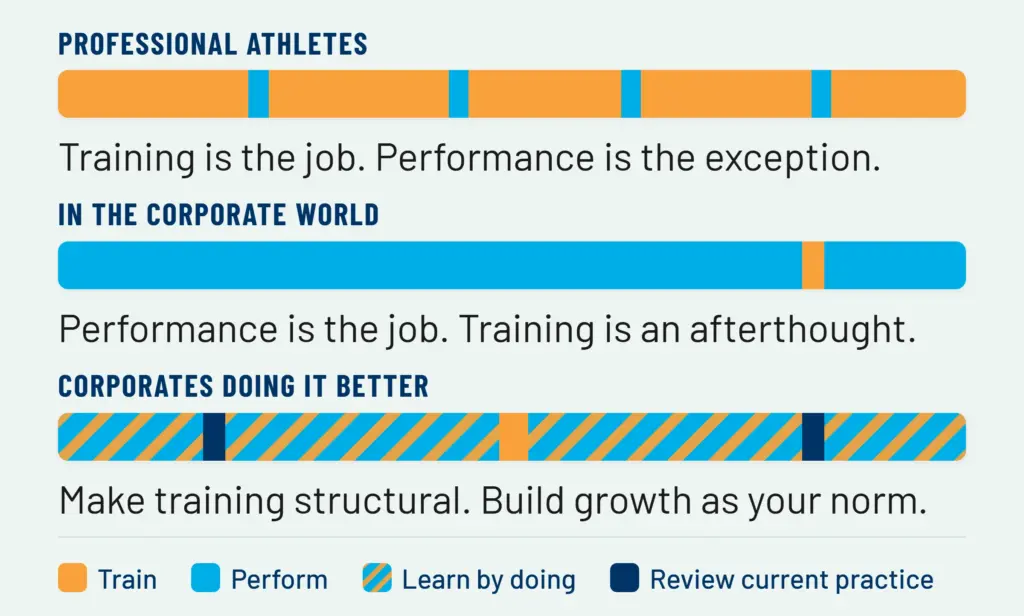
For an elite athlete, training is the infrastructure their whole career is built on. They practice, get coaching, analyse video breakdowns and recover. This is repeated for years before every burst of competition.
Most organisations run the opposite model. Performance happens every day. When you’re lucky, development happens once a year in the shape of a workshop and everyone is expected to go back to the day job having absorbed the new information for good.
The evidence backs up how often that fails. McKinsey’s research on corporate training found that only one in four organisations say their training programs measurably improve business performance, and only 30% track any metric beyond whether people enjoyed the session. Many companies invest heavily in a single event with no real way of knowing whether it changed anything at the everyday level.
And still teams are expected to perform and grow like athletes. Is the gap really a training problem, or might it be a systems problem?
What happens when you don’t “train”
People want training and not offering it costs organisations directly. LinkedIn’s Workplace Learning Report found that 94% of employees say they would stay at a company longer if it simply invested in helping them learn, and organisations with strong internal mobility keep their people for almost twice as long. When development disappears, one of the main reasons for people to stay disappears with it.
Retention is only half the problem though. A workforce that isn’t developing isn’t growing either and a team that stops growing has to buy the capability it can’t build itself. External hires typically cost between 1.5 and 2.5 times the salary of an internal promotion once recruiting, onboarding and ramp up time are added. Research cited by Deloitte suggests it takes an external hire roughly two years to reach the level of institutional insight an internal hire already starts with. Every skill you don’t grow internally becomes a skill you have to buy externally, at a premium, from someone who still has to learn how your business actually works.
The slower cost is readiness. The World Economic Forum’s Future of Jobs Report estimates that 59% of the global workforce will need reskilling by 2030 and that 39% of workers’ core skills are expected to change in that time. Skill gaps are already the single biggest barrier employers report to getting through major change, cited by 63% of them. An organisation that only develops people once a year is not equipped for a world where the skills it needs keep shifting.
None of this gets solved by stopping the business to train, because most of the business genuinely cannot stop. Deadlines, deliveries and decisions do not pause for multiple workshops. The more workable answer is to treat every ordinary working day as a chance to learn something instead of waiting for the one day set aside for it. That is a simple idea but can be a hard habit to build, which is exactly why so few organisations manage it.
What is learning by doing
“Learning by doing” gets used loosely, so it is worth being precise about what it actually means. David Kolb’s experiential learning cycle describes it as four connected steps: having an experience, reflecting on what happened, drawing a lesson or a new idea out of that reflection and then testing the new idea in practice. Without the middle two steps, an experience is just an event. Reflection and conceptualisation are what turn it into learning.
That distinction is important because plenty of what might look like learning by doing is not. Anders Ericsson’s research on deliberate practice found that repetition on its own does not build expertise. Someone can do the same task the same way for ten years and effectively repeat their first year of competence ten times over. What separates real improvement is reflection and feedback: a clear signal about what worked, what did not and what to adjust next time. Doing a task is not the same as learning from it. Doing it, reflecting on it and adjusting is.
What a learning by doing environment looks like
Turning that into something an organisation can actually run needs a few concrete things in place.
Feedback needs to be immediate and specific, delivered close enough to the moment of the work that people can act on it, rather than surfacing months later. Time needs to be protected and allocated to reflection and feedback for people to try a new approach, because a learning by doing culture squeezed around an already full schedule automatically reverts to just doing.
The team also needs a level of safety to go with it. Harvard’s Amy Edmondson, whose 1999 research popularised the idea of psychological safety, found that the highest performing teams she studied reported more errors than the lower performing ones, not fewer.
They were not making more mistakes. Rather, they felt safe enough to surface them, which is the only way a team actually learns from them. And coaching needs to sit close to the work itself rather than at a distance from it. The well known 70-20-10 rule of thumb in learning and development holds that roughly 70% of what people learn at work comes from doing the job itself, 20% from coaching and feedback from other people and 10% from formal training. That 10%, the shared diagnostic and common language a good profile gives a team, is the essential starting point. The problem is that many organisations stop there, without using that starting point to design a plan for the other 90% of their employee’s time.
Put together, this is less a training program that is needed and more an operating environment: an evidence-based picture of who needs what kind of support, feedback that arrives in the moment, protected time to try things, enough safety to admit what did not work and coaching close enough to the work to optimise the results. That is a different thing to build than a workshop and requires a deliberate organisational culture around growth.
Seeing the gap in capabilities
You cannot build sustainable development around a guess. Before investing in a team, an organisation needs an accurate, evidence-based picture of the team.
This is where a psychometric profile can help, such as the Team Management Profile (TMP).
TMP shows each person’s work preferences across four dimensions: how they relate to others, gather information, make decisions and organise their work. Then it maps team members onto the Team Management Wheel against the eight Types of Work every team need covered: Advising, Innovating, Promoting, Developing, Organising, Producing, Inspecting and Maintaining.
Run at team level, this surfaces which Types of Work a team naturally covers well, which are thinly spread and where the team may be skipping an important type of work, or leaning heavily on just a few people to do work that doesn’t play to their preferences. With one assessment you get one evidence-based read of where the team strength and gaps sit, before designing any development session.
Sustaining a learning culture
Seeing the gap and knowing who needs what support to close it still leaves the hardest part: doing it every day, not just in the week after the workshop.
This is what TeamOS™ is built for. Instead of a single block of development squeezed into the calendar once a year, it works as an ongoing coaching layer alongside the team’s everyday work. Oski, the AI coach built into TeamOS, offers briefings ahead of key meetings, suggests concrete next step to take with a colleague, how to offer feedback, or balance a team gap and keeps the picture of team composition current as circumstances change. That support is personalised, using the psychometric data from each team member.
None of that makes the workshop itself less valuable. A well facilitated accreditation session or team workshop is still where people get their first real exposure to a shared language, with a facilitator who can read the room and surface questions teams would not have thought to ask. Those moments do things an app cannot and TeamOS was never built to replace them. What it replaces is the assumption that one good workshop, on its own, is the whole system.
Unlike athletes, businesses don’t get a defined slot for training and another for performing. They get no off-season at all. That is precisely what TeamOS is built to support. It does not ask anyone to step off the field to develop. It puts the coaching inside the game itself, so every ordinary day becomes practice ground instead of waiting for the next scheduled L&D workshop. Every day is a chance to learn and grow. TMP shows you where the gaps are. TeamOS makes sure the coaching keeps happening throughout the year and every moment it is needed.
References
McKinsey & Company, “Getting more from your training programs.” Available at: https://www.mckinsey.com/capabilities/people-and-organizational-performance/our-insights/getting-more-from-your-training-programs
LinkedIn Learning, Workplace Learning Report (94% retention finding and internal mobility data). Available at: https://business.linkedin.com/learn/resources/workplace-learning-report
Mondo, “Internal Hiring vs. External Hiring: Cost-Benefit Analysis” (external hire cost multiples, Deloitte ramp-up estimate). Available at: https://mondo.com/insights/internal-hiring-vs-external-hiring-cost-benefit-analysis/
World Economic Forum, The Future of Jobs Report 2025. Available at: https://www.weforum.org/publications/the-future-of-jobs-report-2025/in-full/3-skills-outlook/
Ericsson, K. A., on deliberate practice, summarised in “Why Corporate Learning Needs Ericsson’s Deliberate Practice More Than Ever,” Forbes. Available at: https://www.forbes.com/sites/ulrikjuulchristensen/2020/06/22/why-corporate-learning-needs-ericssons-deliberate-practice-more-than-ever/
Edmondson, A. C. (1999), “Psychological Safety and Learning Behavior in Work Teams,” Administrative Science Quarterly. Available at: https://journals.sagepub.com/doi/10.2307/2666999
Whatfix, “The 70-20-10 Model for Corporate L&D” (McCall, Lombardo and Eichinger, Center for Creative Leadership). Available at: https://whatfix.com/blog/70-20-10-model/
tivity-bcg-study/