Diagnose Your Team’s Engagement Health: Know What’s Working, What’s Not and Where to Focus Next
Team Signals delivers actionable insights into team engagement and needs, so you can focus on what matters.
Not sure where your team needs support to become high-performing? Team Signals is a research-backed 360° team diagnostic that shows what’s working, what’s missing and where to prioritise interventions. Align your team with purpose, identify psychological risks, quantify impact, facilitate safe conversations and build momentum that lasts.



The Challenge
When a team isn’t working as well as it should, the hardest part is knowing where to start fixing it. Symptoms alone don’t reveal what’s really holding the team back or what will make the biggest difference if addressed.
Teams often experience:
- Loss of momentum without a clear cause
- Friction or disengagement that’s hard to name
- Teams stuck between forming, storming and performing
- Well-intentioned interventions that don’t quite land
Without a clear picture of how the team is functioning right now, effort is easily misdirected.
Team Signals provides that clarity. It gives a fast, high-level diagnosis of how a team is functioning and what it needs to move forward – using team feedback and turning it into a clear starting point for action that will matter most.
How Team Signals Works
Team Signals assesses your team across eight critical dimensions that define high-performing teams:
The 8 Strategic Questions Framework
Team Signals assesses your team across eight critical dimensions that define high-performing teams:
1. Who Are We?
Team identity, shared values and sense of purpose.
2. Where Are We Now?
Current performance levels and engagement benchmarking.
3. Where Are We Going?
Vision clarity, goal alignment and strategic direction.
4. How Will We Get There?
Execution plans, strategy clarity and pathway definition.
5. What Is Expected of Us?
Role clarity, responsibilities and success metrics.
6. What Support Do We Need?
Tools, skills, resources and leadership gaps.
7. How Effective Are We?
Results measurement, feedback loops and output quality.
8. What Recognition Do We Get?
Appreciation, morale and acknowledgment of contributions.
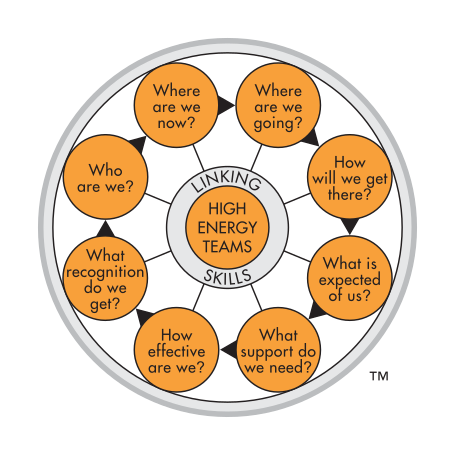
High-Energy Teams Model
The Traffic-Light Dashboard
Results are displayed as a visual dashboard showing:
Strengths
Areas where your team excels
Quick Wins
Areas ripe for immediate improvement
Risks
Areas requiring urgent attention
Why This Matters
From this diagnostic, you get:
A complete snapshot of team functioning
Individual perspectives combined with an aggregated team view
Specific, actionable strategies for improvement
Baseline data for tracking progress over time
What You Get

Why Team Signals Works
Built on the High-Energy Teams Framework
Team Signals is grounded in 40+ years of TMS Global research on what makes teams effective. The High-Energy Teams framework has been validated across:
- Thousands of teams globally
- Diverse industries and cultures
- Teams of all sizes and structures
- Virtual, hybrid and co-located teams
Team Signals is designed for continuous improvement. Benchmark how engaged your teams are, measure development program impact, identify areas of growth and use for relevant ROI reporting.
360° Multi-Rater Perspective
Unlike manager-only assessments, Team Signals captures input from:
- Team members across all levels
- Multiple perspectives on the same issues
- A balanced view combining leader and team insights
Result: You don’t get a filtered view of how your team is functioning – you get a multi-dimensional perspective. All team members have a safe voice to raise concerns, ensuring organisational psychosocial due diligence.
Efficient and Non-Disruptive
32 questions. 15 minutes. Done.
Your teams are busy. Team Signals respects their time whilst delivering comprehensive insights. The survey is short with focused questions on what matters.
How Team Signals Integrates with the Complete TMS Global System
Team Signals is the diagnostic entry point in the TMS Global system. On its own, it shows where a team is struggling. Combined with TMS profiles, it helps leaders and practitioners understand how to address those issues effectively.
Complete Team Insight
Diagnose where to focus and know how to act – especially for leadership teams.
Combine: Team Signals + TMP + QO2
How these products work together
- Team Signals diagnoses how the team is functioning right now and highlights priority focus areas
- TMP explains how work preferences and role contribution may be influencing those issues
- QO2 shows how risk orientation, resilience and responses to uncertainty are shaping behaviour
Result: Clear diagnosis of where the problem sits (Team Signals), supported by insight into how people work and respond under pressure (TMP + QO2) – enabling targeted, practical team interventions.
Focused Team Development
Identify the issue, then address it with precision.
Combine: Team Signals + TMP
How these products work together
- Team Signals identifies the specific areas of team functioning that need attention
- TMP provides practical guidance on how to adjust roles, collaboration and ways of working
Result: A fast, evidence-based way to move from diagnosis to action – using Team Signals to prioritise and TMP to guide concrete changes in how the team works together.
Using our diagnosis plus our profile tools moves you from surface symptoms to root causes, and from generic advice to targeted solutions.
Success Stories

Backed by robust research. Validated. Support is provided by an incredible team of experts. Multiple layered products that provide solutions to a wide range of problems. Trusted by millions of people from diverse cultures across the globe.
The products are cost effective and user friendly, yet backed by decades of thorough scientific research.
Team Signals gave the new leaders a simple language and clear data to take ownership of their journey, sparking rich conversations, a shared sense of direction and co-created business plans. It also provided documented data for executive reporting to prove the investment was working.
Get Started with Team Signals

For Organisations & Teams
Find a TMS Global Practitioner
Work with one of our 24,000+ accredited practitioners to deploy Team Signals across your teams.
Speak with a TMS Global Expert
Want to understand how Team Signals fits your specific needs? Let’s talk.
Download a Sample Report
See the traffic-light dashboard and actionable insights Team Signals delivers.

For Consultants & HR Professionals
Get TMP Accredited (Includes Team Signals)
TMP accreditation includes the ability to deliver Team Signals. Join 24,000+ practitioners globally.
Already TMP Accredited?
You can start delivering Team Signals immediately. Access facilitation guides and materials through your TMS Global Portal.
Frequently Asked Questions
How is Team Signals different from annual engagement surveys?
Team Signals is formative (looks at the present of the team and action-focused) whilst most engagement surveys are summative (retrospective, reporting-focused). Team Signals gives a voice to the whole team plus their manager, and guides immediate action by signalling team gaps.
Can Team Signals replace our existing engagement survey?
It depends. Team Signals measures team effectiveness, not individual employee satisfaction or organisation-wide engagement. It’s ideal for team-level pulse checks and development interventions.
How often should we use Team Signals?
Most teams use Team Signals: once for new team formation, quarterly as pulse checks for ongoing teams, pre/post to measure program or intervention impact and as-needed when team health concerns arise.
Do I need special training to deliver Team Signals?
If you’re TMP-accredited, you can deliver Team Signals immediately – no additional training required. If you’re not yet accredited, TMP accreditation includes Team Signals delivery capability.
How long does Team Signals take to complete?
15 minutes for the questionnaire. Debrief sessions typically run 90 minutes to 2 hours, depending on team size and depth of conversation.
Can remote teams use Team Signals?
Yes. The questionnaire is online and accessible from anywhere. Debrief sessions can be facilitated virtually or in-person.
What’s the minimum team size for Team Signals?
Team Signals works best with teams of 4-15 members. Smaller teams may not benefit from aggregated reporting; larger teams may need to be segmented into sub-teams.
How do results stay confidential?
Individual responses are aggregated and anonymised in team reports. Leaders see overall patterns, not individual responses, ensuring psychological safety for honest feedback.
Can we track progress over multiple assessments?
Yes. Team Signals creates baseline data that you can compare against future assessments. This allows you to measure improvement over time and track the impact of development initiatives.
What happens if the results show serious team dysfunction?
Team Signals identifies issues – it doesn’t solve them. Results should be debriefed by a skilled facilitator (TMS Global Associate or internal TMP-accredited professional) who can guide the team through difficult conversations and create action plans.
Measure Your Team’s Engagement
Team Signals gives you:
- Clear priorities so you know where to focus team and leadership development
- Actionable strategies grounded in team feedback
- Proof of progress over time
Whether you’re an HR leader seeking continuous team health monitoring, a consultant needing measurable pre/post diagnostics, a team leader navigating change or transition or an executive tracking leadership effectiveness – Team Signals delivers clarity on any team’s health, so you can act with confidence.